
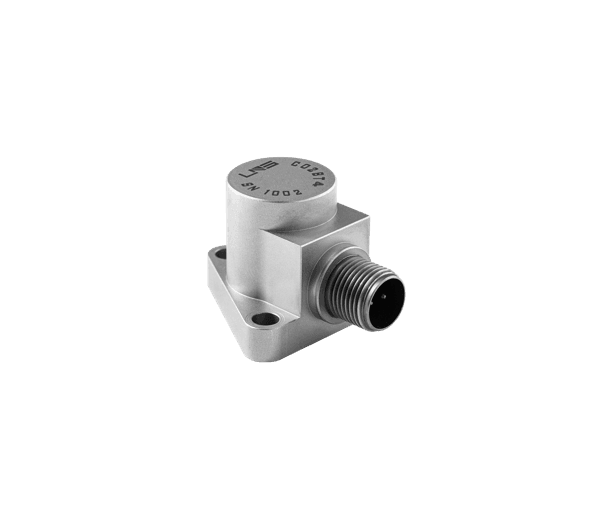
C03BT4
High-Temperature Charge Accelerometer
Uniaxial
Sensitivity: 20pC/g
Range: ±1000g
Frequency (5%): 1-9k Hz
Temp Range: -50~260°C
Connector: 7/16-27 2pin
Mount: M4×3 Thru-Hole
- Fast Lead Time
Overview
The C03BT4 is a charge-mode (PE) ultra-high-temperature accelerometer built on ultra-high-temperature piezoelectric ceramics with an ultra-low sensitivity temperature coefficient and high impedance maintained right up to 260 °C. With 20 pC/g charge sensitivity and a ±1,000 g range it is the mid-sensitivity 260 °C member of the family. Typical uses include engine and exhaust vibration, turbine and turbocharger testing, high-temperature industrial monitoring and thermal-cycle rigs to 260 °C.
With no built-in electronics the sensor works from −55 °C to +260 °C and pairs with any charge amplifier, which sets the low-frequency limit of the system. A special high-temperature nickel-based alloy housing and matched piezoelectric material keep temperature drift low, and the signal ground is isolated from the housing for a differential output that rejects interference on long cable runs from hot zones. The laser-welded 33.7 × 30.2 × 25.3 mm housing weighs 62 g, is sealed to IP68, bolts down through three ⌀4.6 mm through-holes in a stable triangular pattern with M4 screws torqued to 1.8 N·m, and carries an industry-standard 7/16-27 two-pin connector, compatible with domestic and international high-temperature metal cables.
Why engineers choose the C03BT4

Rated to 260 °C
Ultra-high-temperature piezoceramics with an ultra-low sensitivity temperature coefficient keep the C03BT4 reading accurately from −55 °C to +260 °C, with ≥ 10¹⁰ Ω insulation resistance held at temperature and 1,300 pF capacitance into any charge amplifier. No internal electronics, so nothing to fail in the heat.

Differential, isolated output
Signal ground isolated from the housing (≥ 10¹⁰ Ω) with a two-pin differential output, so long metal-sheathed cable runs from engine bays and turbine casings stay free of ground loops and pickup. ±5% response over 1 – 9k Hz (±10% over 1 – 11k Hz), resonance ≥ 45 kHz, ≤ 5% transverse sensitivity.

Nickel alloy, triangular mount
Laser-welded nickel-based alloy 33.7 × 30.2 × 25.3 mm housing weighing 62 g, sealed to IP68 and rated to 2,500 g rms vibration and 4,000 g pk shock. Three ⌀4.6 mm through-holes give a stable, easy triangular fixing with M4 screws, and the 7/16-27 two-pin connector takes standard high-temperature metal cables.
Typical applications
 Automotive engine and exhaust testing
- Gas turbine and turbocharger vibration
- High-temperature industrial vibration monitoring
- Combustion and thermal-cycle test rigs
- Heat-shield and manifold structural vibration
- Long-term monitoring on hot machinery to 260 °C
What’s in the box
- C03BT4 ultra-high-temperature accelerometer
- Product calibration certificate
- Mounting screws (M4 × 10)
Options & accessories
- Recommended high-temperature metal cable K73CC75 – use the Cable Builder or contact us
- Charge amplifiers and charge-input signal conditioners for high-temperature channels – contact us
Key specifications
Other models in the ultra-high-temperature family
Same ultra-high-temperature piezoceramics, charge output, nickel-based alloy housing, isolated differential output and triangular through-hole mount across the family. BT4 models are rated to 260 °C, BT3 and CT3 to 500 °C; BT models have a 7/16-27 two-pin connector, CT models an integral high-temperature cable. Choose the temperature rating, sensitivity and connection that fit your installation.
| Model | Sensitivity | Range | Frequency (±5%) | Max temp | Connection · weight |
|---|---|---|---|---|---|
| C02BT4 | 10 pC/g | ±1,500 g | 1 – 10k Hz | +260 °C | 7/16-27 2-pin · 61 g |
| C03BT4This model | 20 pC/g | ±1,000 g | 1 – 9k Hz | +260 °C | 7/16-27 2-pin · 62 g |
| C05BT4 | 50 pC/g | ±500 g | 1 – 6k Hz | +260 °C | 7/16-27 2-pin · 75 g |
| C02BT3 | 10 pC/g | ±600 g | 10 – 5k Hz | +500 °C | 7/16-27 2-pin · 80 g |
| C05BT3 | 50 pC/g | ±500 g | 10 – 2.5k Hz | +500 °C | 7/16-27 2-pin · 95 g |
| C02CT3 | 10 pC/g | ±600 g | 10 – 5k Hz | +500 °C | Integral cable · 75 g |
| C05CT3 | 50 pC/g | ±300 g | 10 – 2.5k Hz | +500 °C | Integral cable · 105 g |
 C03BT4 datasheet (PDF)
| Sensitivity (pC/g) | 20 |
|---|---|
| Range (g) | 1000 |
| Linearity | 1% |
| Min Frequency [5%] (Hz) | 1 |
| Max Frequency [5%] (Hz) | 9000 |
| Resonant Frequency (kHz) | ≥40 |
| Transverse Sensitivity | ≤5% |
| Capacitance (pF) | 1300 |
| Acceleration Limit (g) | 2500 |
| Max Shock (g) | 3000 |
| Temperature Range (℃) | -50~260 |
| Min Temperature (℃) | -50 |
| Max Temperature (℃) | 260 |
| Sensitivity Temperature Coefficient (%/℃) | 0.02 |
| Sealing | Laser Welding IP68 |
| Housing Material | Nickel Alloy |
| Output Connector | 7/16-27 2pin |
| Mounting | M4×3 Thru-Hole |
| Weight (grams) | 62 |
| Axis | Uniaxial |
| Output Type | Charge |
- Datasheet (PDF): C03BT4
- Manual (PDF): Op. & Installation Guide
Related products
-
B02B00
General Purpose IEPE Accelerometer
Uniaxial
Sensitivity: 10mV/g
Range: ±500g
Frequency (5%): 2-10k Hz
Temp Range: -40~120°C
Connector: Side
Mount: 10-32/M5 Female -
B03A00
General Purpose IEPE Accelerometer
Uniaxial
Sensitivity: 20mV/g
Range: ±250g
Frequency (5%): 1-10k Hz
Temp Range: -40~120°C
Connector: Top
Mount: 10-32/M5 Female -
B01Y41
Triaxial Thru-Hole IEPE Accelerometer
Sensitivity: 5mV/g
Range: ±1000g
Frequency (5%): 2-9k Hz
Temp Range: -50~120°C
Connector: 1/4-28 4pin
Mount: Thru-Hole -
B09A01
General Purpose IEPE Accelerometer
Uniaxial
Sensitivity: 500mV/g
Range: ±10g
Frequency (5%): 1-5k Hz
Temp Range: -40~120°C
Connector: Top
Mount: 10-32/M5 Female