
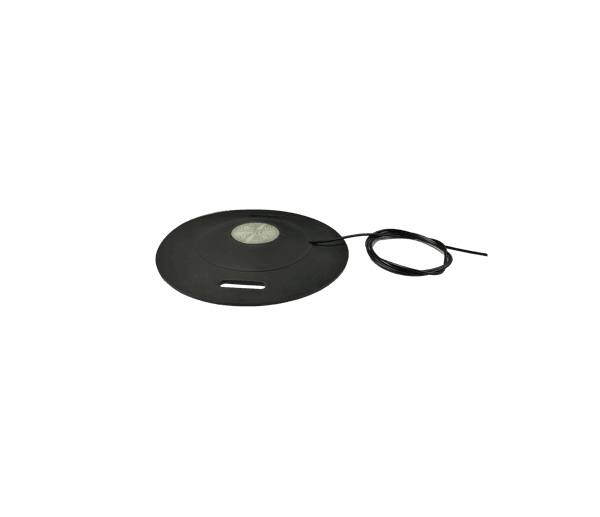
B06H46
Seat Cushion IEPE Accelerometer
Triaxial
Sensitivity: 100mV/g
Range: ±50g
Frequency (5%): 1-4k Hz
Temp Range: -40~120°C
Connector: Integral Cable (1/4-28 4pin Jack)
- Fast Lead Time
Overview
The B06H46 is a three-axis IEPE seat cushion accelerometer for seat vibration testing. A titanium-housed triaxial shear-mode sensor sits inside a flat rubber pad that goes between the occupant and the seat, so it measures the vibration actually reaching the person under real road, track and off-road conditions. With 100 mV/g sensitivity, a ±50 g range and a 4 µg/√Hz noise floor at 100 Hz, it resolves the low-level, low-frequency motion that decides ride comfort. Typical uses include seat comfort, handling and reliability research, whole-body vibration exposure testing on construction and agricultural vehicles, seat development and validation, and seat suspension, mounting bracket and damping tests.
The built-in IEPE circuit runs from any 2–20 mA constant-current source with an 8–12 V bias and brings all three channels out on a 1 m integral K00BB05-1M cable terminated in a single 1/4-28 4-pin connector, so one extension cable connects the pad to a standard IEPE DAQ. The pad measures ⌀200 × 16.5 mm and weighs about 340 g in total, the sensor element is laser-welded titanium sealed to IP68, and the polyurethane cushion needs no mounting hardware: place it on the seat, sit on it and measure.
Why engineers choose the B06H46

Measures what the driver feels
The flat rubber pad sits between the seat and the occupant, so the three axes capture the vibration transmitted through the seat cushion, backrest or floor rather than the frame it is bolted to. The standard way to quantify ride comfort and whole-body vibration exposure.

Low-level, low-frequency resolution
100 mV/g shear-mode sensor with a ±5% response from 1 Hz to 4 kHz (±10% over 0.5 – 6k Hz), spectral noise of 15 / 4 / 2 µg/√Hz at 10 / 100 / 1000 Hz and 0.0001 g rms broadband resolution, so the sub-10 Hz content that matters for comfort is measured cleanly.

Three axes, one cable, no mounting
Simultaneous X, Y and Z from a single sealed titanium element with ≤ 5% transverse sensitivity, brought out on the integral K00BB05-1M cable and its 1/4-28 4-pin connector. No studs, adhesive or brackets: the pad is placed on the seat and is ready to measure in seconds, rated to 400 g rms and 2,000 g pk.
Typical applications
-
 Seat comfort, handling and reliability research
-
Whole-body vibration exposure on construction and agricultural vehicles
-
Seat development and validation testing
-
Seat suspension, mounting bracket and damping tests
-
Vehicle ride comfort and NVH
-
Operator exposure measurement on off-road and industrial machinery
What’s in the box
-
B06H46 seat cushion triaxial accelerometer with integral K00BB05-1M cable (1 m)
-
Product calibration certificate
Options & accessories
-
Integral cable – supplied as K00BB05-1M (1 m) by default; other lengths available – contact us
-
Recommended cable K06BB72 (1/4-28 4-pin) – build yours in the Cable Builder
-
Multi-channel IEPE signal conditioners and DAQ for seat and ride comfort testing – contact us
Key specifications
 B06H46 datasheet (PDF)
| Sensitivity (mV/g) | 100 |
|---|---|
| Range (g) | 50 |
| Broadband Resolution (g rms) | 0.0001 |
| Linearity | 1% |
| Frequency Range [5%] (Hz) | 1-4k |
| Min Frequency [5%] (Hz) | 1 |
| Max Frequency [5%] (Hz) | 4000 |
| Frequency Range [10%] (Hz) | 0.5-6k |
| Resonant Frequency (kHz) | ≥20 |
| Discharge Time Constant (s) | ≤1 |
| Transverse Sensitivity | ≤5% |
| Excitation Voltage (Vdc) | 20-30 Vdc |
| Constant Current Excitation (mA) | 2-20 mA |
| Output Impedance (Ω) | ≤100 |
| Output Bias Voltage (V) | 8-12 Vdc |
| Max Acceleration (g) | 400 |
| Max Shock (g) | 2000 |
| Temperature Range (℃) | -40~120 |
| Min Temperature (°C) | -40 |
| Max Temperature (°C) | 120 |
| Sensitivity Temperature Coefficient (%/℃) | -0.07 |
| Sealing | Laser Welding IP68 |
| Housing Material | Titanium Alloy |
| Output Connector | 1/4-28 4pin |
| Mounting | Adhesive |
| Weight (grams) | 340 |
| Sensor Type | Seat Cushion |
| Output Type | IEPE |
| Axis | Triaxial |
| TEDS Optional | No |
- Datasheet (PDF) B06H46
- Manual (PDF) Op. & Installation Guide
- Selection Guide (PDF) Accelerometer Selection Guide
- Popular Cables K06BB72
Related products
-
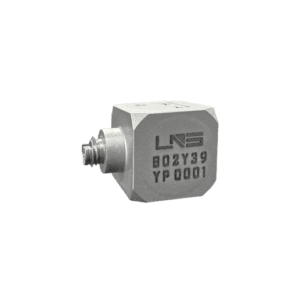
B02Y39
Triaxial Cube IEPE Accelerometer
Sensitivity: 10mV/g
Range: ±500g
Frequency (5%): 1-8k Hz
Temp Range: -40~120°C
Connector: 8-36 4pin
Mount: M2.5 Female -
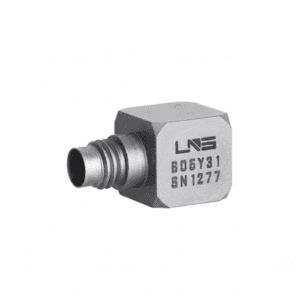
B05Y31
Triaxial Cube IEPE Accelerometer
Sensitivity: 50mV/g
Range: ±100g
Frequency (5%): 1-7k Hz
Temp Range: -40~120°C
Connector: 1/4-28 4pin
Mount: M2.5 Female/Adhesive -
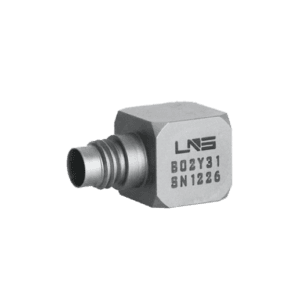
B02Y31
Triaxial Cube IEPE Accelerometer
Sensitivity: 10mV/g
Range: ±500g
Frequency (5%): 1-8k Hz
Temp Range: -40~120°C
Connector: 1/4-28 4pin
Mount: M2.5 Female/Adhesive -
B06A00
General Purpose IEPE Accelerometer
Uniaxial
Sensitivity: 100mV/g
Range: ±50g
Frequency (5%): 1-8k Hz
Temp Range: -40~120°C
Connector: Top
Mount: 10-32/M5 Female